SPI Dot Matrix
Light an 8x8 LED matrix over SPI (picoruby-spi).
The last of the common bus protocols is SPI. This is the one used in the author’s RubyKaigi 2025 demo.
Parts
- A MAX7219 8×8 dot-matrix LED module
Circuit
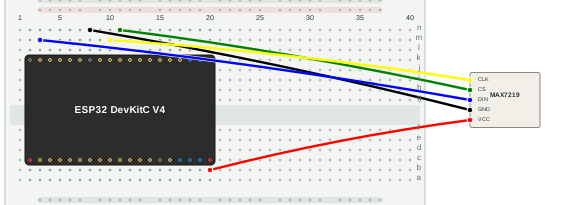
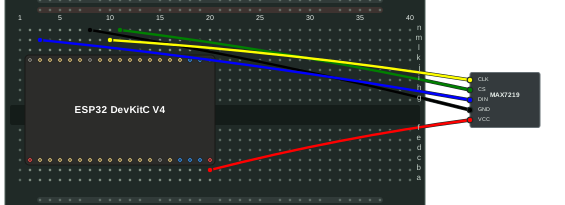
| MAX7219 module | ESP32-DevKitC |
|---|---|
| VCC | 5V |
| GND | GND |
| DIN | GPIO23 (VSPI MOSI) |
| CS | GPIO5 (VSPI SS) |
| CLK | GPIO18 (VSPI SCLK) |
Program
Like the OLED, the module defines its commands in a datasheet. The program first sends the initialization commands, then switches each LED on or off with one bit per LED, eight rows of eight.
require 'spi'

spi = SPI.new(unit: 'ESP32_VSPI_HOST', frequency: 10_000_000, sck_pin: 18, cipo_pin: 19, copi_pin: 23, cs_pin: 5, mode: 0, first_bit: 0)

spi.write([0x0c, 0x01])
spi.write([0x09, 0x00])
spi.write([0x0a, 0x0f])
spi.write([0x0b, 0x07])

[
  0b01010101,
  0b10101010,
  0b01010101,
  0b10101010,
  0b01010101,
  0b10101010,
  0b01010101,
  0b10101010,
].each_with_index do |val, i|
  spi.write([i + 1, val])
end

loop { sleep_ms(500) }
Run
Save the program as spi.rb and put it in /home on the device (see
File Transfer), then run it from the shell:
$> ./spi.rb
A checkerboard pattern should light up on the dot matrix.
On this page